
The Train Pusher
A short story

Enjoy Maelstrom, the theme song to The Train Pusher, written and sung by Marina V. You can listen to more of Marina V’s beautiful songs and read the lyrics to Malstrom here.
“I don’t want to move to another part of Tokyo or anywhere else. Our neighborhood has everything, including good schools for when we have a baby.” Akari nudged Jiro’s tie to the side to make sure it wouldn’t dip into the cereal.
They sat on either side of the small table in their small kitchen located in their small, four-story apartment building. One analog wall clock and two digital table clocks faced Jiro’s seat, a system designed to ensure he wouldn't be late for work. Jiro handed Akari half of the Asahi Shimbun and skimmed yesterday’s baseball games and sumo matches.
“I assume you are kidding when you suggest we move.” When he didn’t answer, Akari snatched Jiro’s section, the paper snapping like a thunderclap. “It’s only thirty minutes on the JR Line and a quick walk to the station. You can do it. You listen to music on the train, so it's like a vacation.”
Jiro wanted his paper back, but what did it matter? He barely found time to read the headlines.
His life was a nonstop treadmill, and he wondered if he suddenly jumped off, would he crash into the wall behind him?
“I think a quieter neighborhood would be better. Something not so hustle and bustle.”
“I like the convenience of having everything close. Also, it’s too expensive to move, so this discussion is closed.”
Jiro glanced at his watch: 6:50 a.m. Time to leave.
“Okay,” he said. He sighed, slid his chair back, and stood. It wasn’t a matter of who was right, or that the morning commute was the opposite of Akari's idea of a vacation. They weren’t moving because life's inertia was too powerful to counter. This neighborhood, this accelerated pace, was their life now, and trying to change it, Akari, or anything else, was impossible.
When he was a kid, he wished on stars. Those were hopeful days; his future was his boundless imagination. Those memories faded more with every passing day.
He kissed Akari goodbye, tightened his tie in the hallway mirror, picked up his briefcase, and trudged nine minutes to the train station.
Jiro switched briefcase hands as he waited for the train. The weight of the papers and responsibilities inside strained his arm. He stood amidst a sea of black suits, in the third row from the train platform edge, with another ten layers of salarymen behind him.
The sweaty mass of humanity and the sound of metal against metal as trains entered and departed the station hammered every cell of his body.
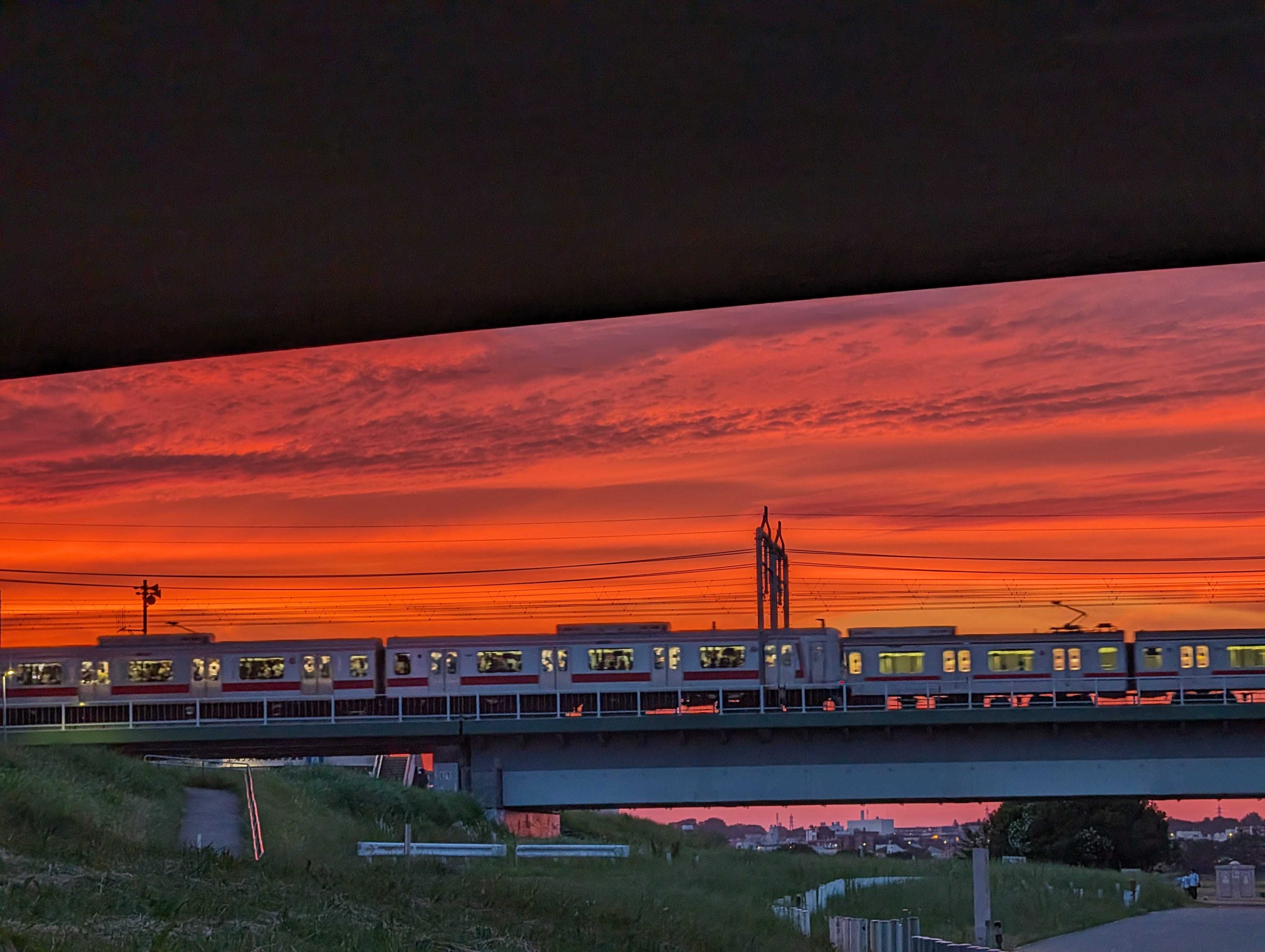
As the train pulled into Takadanobaba station, he tightened his back muscles, stiffened his spine, and willed his legs to become rubber. The train door opened, and Jiro twisted halfway into the train, one arm, hip, and left leg inside, but his right leg still lingered on the platform, an impediment to both the JR Line’s schedule and his physical well-being. Jiro grunted and rotated his back to the platform to prepare for the push. Two white-gloved, uniformed pushers converged on him, like bees materializing out of the ether at a picnic. Anonymous hands forced the rest of Jiro into a space nature never intended for a human being to fit into.
After they squished Jiro into the protoplasmic horde of humanity, the pressure from the surrounding passengers wedged him in place. Now, each passenger radiated heat like the noon sun, scorching his lungs. His face pancaked flat against the train door window, like he was a two-dimensional being. Somebody’s hard-sided briefcase was on the cusp of prying off his kneecap. Jiro knew that person was in pain, too.
At work, Jiro’s fingers melted into his keyboard; his head and headset fused into a single entity. His eyes fixed on the flow chart that detailed the current supply chain for the satellite radios his company produced. The chart mutated weekly; supply chains churned as chaotic entities, like leaves in the autumn wind, subject to the whims of tariffs, shipping companies, ocean storms, and a hundred other factors.
Jiro mused on how things were made in the days before computers could track and coordinate such complex systems. It must certainly have been slower, but somehow cars got built, as did a myriad of appliances and products.

After work, Jiro meandered back to the station, another nine or so minutes' walk. He didn’t mind his after-work walk, though, because, while tired, he could take his time—no pressure to be somewhere. His walk to the station often carried him along streets he’d never seen before, such was Tokyo’s random, labyrinth-like design.
He glanced at his watch. Six-fifty-three. Nearly twelve hours since he started his work day, if you count getting to and from the office, which in Jiro’s estimation, definitely counts.
His feet traced one of those streets he’d never seen, and when his eyes caught the exterior of a tea shop, his brain urged, Stop. Rest. Rejuvenate. You’re in no rush to get home.
“Welcome to my tea shop,” the shop’s proprietor, who introduced himself as Eiichi, said. He had thick, silver hair and a slightly bent nose that appeared to have been broken and never reset. Even at seventy-plus years, he was a large man, muscles hiding underneath his shirt. He looked like a former rugby player.
“I haven’t seen your ochaya-san before. Is it new?”
Jiro surveyed the small room. Three squat wooden tables, each with four short wooden stools, filled the small room. Paper-covered hanging lamps illuminated a dozen Ukiyo-e paintings on the walls, including The Great Wave off Kanagawa, drawn by Hokusai in 1831.
Jiro noticed an old-style rotary telephone on the counter.
That can’t still work.
“We’ve been here since nineteen-fifty. Most people just pass us by.” Eiichi shrugged. “Those who enter do so because they need to. Tea is more calming after work than beer or whisky, don’t you think?”
Jiro settled onto a stool, and Eiichi placed a cup in front of him. Jiro thought it odd that the proprietor didn’t offer him a menu first.
Steam wafted from the cup, carrying symphonic aromas of a thousand herbs to Jiro’s nose. The tea was still too hot to drink, but Jiro savored the herbal scents while he waited for it to cool.
Except for Jiro and Eiichi, the shop was empty. This didn’t surprise Jiro. Bars were the venue of choice for decompressing after work.
Work hard, drink hard.
Jiro lifted the cup to his lips and blew a stream of cooling air over the liquid’s surface before taking his first sip. Mint, ginger, rooibos, rose petals, and a plethora of unidentifiable flavors saturated his tongue. Bright, loud colors like fireworks ignited in his brain, and his skin tingled like it radiated with sparklers.
“This is good tea.”
“It’s better than good,” Eiichi replied. He took a long, satisfying sip from his teacup and said, “You’ll love it even more the next time.”
Akari moved Jiro’s tie to the side so it wouldn’t dip into the cereal bowl, even though it was nowhere near his cereal, and was too short to reach the bowl anyway. Jiro passed her the half of the newspaper he wasn’t reading, and continued eating his cornflakes. His watch read 6:49 a.m., one minute before he had to leave to catch the 7:04 a.m. train.
As Jiro waited on this August morning on the train platform along with hundreds of other bodies, he heard his sweat thunk onto the ground. The train would arrive soon, the car would be air-conditioned, but what good was air conditioning when pressed against so many other sweating people?
When the train arrived, he forced himself through the train doors as far as he could. Jiro reached for a hand strap, which he used to pull himself even further inside, but half his body remained outside the doors. A pusher arrived to help Jiro the rest of the way into the train. This pusher was a man in his seventies with silver hair and a wrestler’s body, a contrast to the youthful staff commonly employed as pushers. He recognized the pusher—Eiichi, the tea shop owner.
What?
Eiichi winked at Jiro before giving him the hardest shove he’d ever received.
Jiro propelled forward into the train and beyond. The throng of bodies that filled the car transformed into a swirling cloud of multicolored dust, enveloping Jiro. There was a loud pop, and Jiro tumbled through the car’s void.
Where is everyone?
A half dozen men and women stared at Jiro as he picked himself off the floor. Two women wearing ankle-length dresses, one a paisley pattern, the other covered in blue, yellow, and green squares and rectangles, shook their heads, mouths agape. One of the men, dressed in a long, beige raincoat with wide lapels and skinny tie, helped Jiro to a seat. He asked Jiro where he had come from, saying that one moment he wasn’t here, and the next he was, as if he had materialized out of thin air.
Jiro shook his head and rubbed his eyes.
He was riding a streetcar.
Where is the JR train?
Jiro blurted a quick “Thank you,” and exited. He looked back as the green and white streetcar glided along tracks laid on cobblestone. A second green and white streetcar traveled along tracks on the far side of the street in the opposite direction, and a pink and red one followed tracks along a perpendicular route. All the cars’ windows were open. The sky above the streetcars was a web of wires spun by a drunk spider.
A man on a loud motorbike carrying three passengers zipped past the streetcar that Jiro had been riding. A handful of bulbous automobiles with big, chrome fenders ambled along.
Women pushed oversized metal strollers.
Jiro passed by a shoeshine man. A flock of school kids, none with phones, dressed in black uniforms and white shoes, paraded along the opposite side of the street.
Something was wrong, but everything was right. He felt his heart steady, a strange sensation because he’d never noticed it beating before.
Jiro rubbed his back where Eiichi shoved him, half expecting to find a knife wound, which would explain things: an infection exploding in his blood, his body feverish, his brain delirious. But Jiro felt nothing except for the ache of Eiichi’s powerful push.
The tea man, the train pusher. Eiichi.
He looked around and took in an alien Tokyo.
His eyes soaked in neon signs advertising restaurants, shopping centers, pachinko parlors, and an upcoming baseball game between the American All-Stars and the Yomiuri Giants. There was a window display for women’s bathing suits with real models.
Jiro peered inside a yellow newspaper box. Today was September 4th, 1950.
The once unalterable trajectory of his life had been a speeding missile. Now he felt a new emotion: hope.
This was Tokyo from before he was born. A thousand questions rattled his brain, but each question led to the same conclusion: The answers were at the tea shop.
Jiro ambled on automatic pilot, passing through residential neighborhoods, which in his time, had been—would be—busy business districts. The world was off kilter.
A girl in a kimono balanced inside a hula hoop, and a family of three was eating a picnic lunch on their front lawn. In Tokyo! A man was taking a photograph of a woman with a large, box-shaped camera like something out of a vintage movie, while nearby, an elderly man shuffled in geta, wooden platform shoes.
Jiro slid open the door to the tea shop, which he now noticed bore no name, revealing nothing to indicate that it was an ochaya-san.
Had there been a sign before? I mean, will there be a store sign?
Jiro stepped inside.
A cacophony of aromas filled his nose and ears.
How do scents have sounds?
The tea smells rang like wind chimes.
A woman in her forties, dressed in a modern suit, like Jiro, sat at the table nearest the door. Her stylish black-framed eyeglasses matched her clothes. She nodded to Jiro, who sat down on the opposite stool.
“Are you—?” Jiro started to ask.
“Yes, like you.”
“When did you—?”
“Just a few minutes before you arrived.” She bowed and took a sip of her tea. “I’m Rin, former general manager at HikariTech, former resident of the year twenty-twenty-five.”
“What did he do to us?”
“I pushed you,” Eiichi said.
Jiro turned to him.
“You did what?”
Eiichi pulled on his apron’s strings to tighten it.
“I pushed you from two-thousand twenty-five to nineteen-fifty.” He rested a teacup in front of Jiro. “To answer your next question, it does have to do with the tea, a recipe that's been in my family since the Heian period. I know you have more questions, and I will try to answer them all, but I need to tell you this first: You must drink a cup of this tea once a week to stay in this time, just as you needed the tea to arrive here."
“The Heian period was a thousand years ago," Jiro said.
“Hmm, so it was.”
“Why did you push me back to nineteen-fifty?”
“I think you know the answer. It’s the same answer for you as for Rin. You longed for this.”
Yes.
Jiro took another sip of tea.
Where do I work? What can I do in this time?
But whatever he did, it would be slower and quieter. He smiled.
The bell above the shop's door announced two new visitors.
“Mitsuki, Hiroto! Welcome. Have a seat with Rin and Jiro from two-thousand twenty-five.” He turned to the table. “Mitsuki and Hiroto are from two-thousand fifty-six. They come every Wednesday for tea.”
If you enjoyed this story, consider buying me a coffee. Readers inspire me to write.
If you liked The Train Pusher, I think you’ll also like Winnie the Pooh Versus the Dragon.
The stresses of the life Jiro has are intense! I get the feeling Akari doesn’t want to know.
How amazing to be able to escape so completely!
Are train pushers real in Japan?
I'm looking for that train pusher next time I'm at Baba.